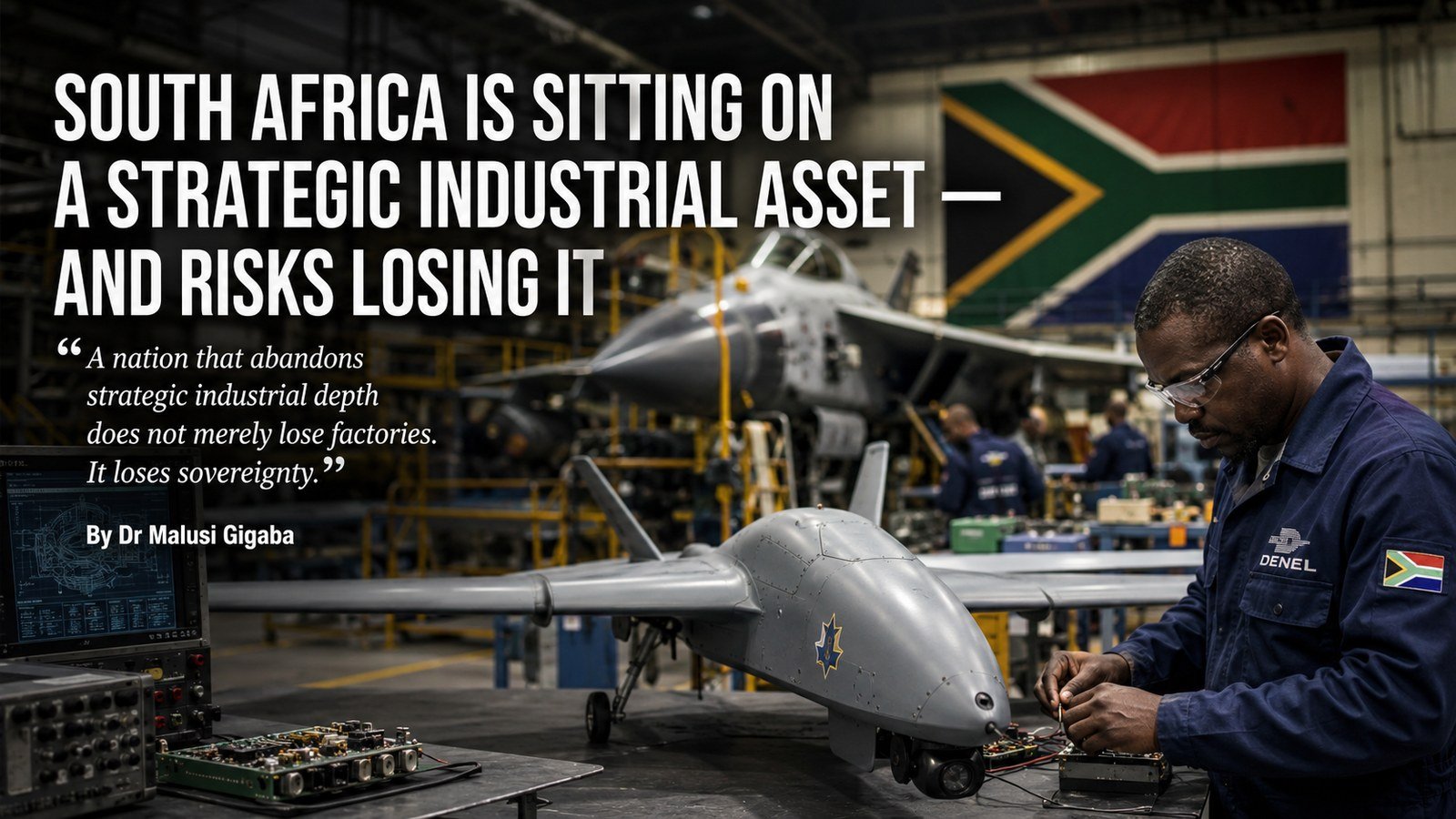
A declining defence budget is not merely a military concern. It raises deeper questions about industrial policy, technological sovereignty, economic development and South Africa’s long-term strategic autonomy.
South Africa’s defence industry is often discussed only when budgets are cut, procurement controversies emerge, or geopolitical tensions rise. Yet this narrow framing misses a far bigger reality: South Africa is sitting on one of the most strategically important industrial assets on the African continent, and risks losing it through long-term neglect, policy inconsistency, and the erosion of sovereign capability.
This is not merely a defence conversation. It is an economic conversation. It is a technological conversation. It is ultimately a sovereignty conversation.
A nation that abandons strategic industrial depth does not merely lose factories. It loses sovereignty.
The capability few South Africans appreciate
Few South Africans fully appreciate the extent of the advanced industrial capability that exists within our aerospace and defence ecosystem. Over decades, South Africa developed world-class expertise in aerospace engineering, advanced electronics, unmanned systems, precision manufacturing, radar systems, satellite payloads, maritime technologies, software engineering, artillery systems, armoured vehicle design, and battle management systems. These are not low-skill sectors. They represent some of the most sophisticated forms of industrial and technological production any country can possess.
This reality featured prominently during discussions in Parliament on 22 May 2026, where the South African Defence Industry (AMD) presented before the Joint Standing Committee on Defence, together with the Portfolio Committees on Science, Technology and Innovation, and Trade, Industry and Competition. The presentation argued that South Africa still possesses globally competitive intellectual property and engineering capability across aerospace, maritime, cyber, space and advanced manufacturing systems, but that these capabilities are increasingly under pressure due to declining investment, procurement instability and skills erosion.
Why advanced economies build defence industries
The global reality is that nations which lead in advanced manufacturing and technological innovation almost always possess strong aerospace and defence industries. The relationship is not accidental. Aerospace and defence sectors create the conditions for broader technological advancement because they demand high-end engineering, systems integration, research capability, software development, advanced materials science, and complex industrial coordination.
Many of the technologies that today shape civilian life were initially developed within defence and aerospace ecosystems. GPS, satellite communications, advanced navigation systems, cyber capabilities, aviation technologies, drones, advanced composites, and even aspects of the internet itself emerged from strategic state investment into high-end industrial capability. Countries that understand this do not treat defence industries merely as military instruments; they treat them as strategic economic multipliers.
A country that once understood this
South Africa once understood this reality far better than it does today.
The country’s defence industry contributed significantly to transforming South Africa from an economy overwhelmingly dependent on mining and primary extraction into one capable of advanced manufacturing and complex engineering. It helped cultivate generations of engineers, technicians, artisans, systems designers and software specialists. It built institutional knowledge that took decades to accumulate.
The contraction
Yet over time, the industry has steadily contracted due, in large measure, to the decline in defence spending. Employment has declined sharply. Research and development investment has weakened. Local procurement has diminished. Critical skills have left the sector or emigrated. Many firms have consolidated or disappeared altogether. While some globally competitive capability remains, the ecosystem is under growing strain.
This decline is occurring at precisely the moment when global geopolitical instability is driving renewed investment into defence, aerospace, cyber capability and sovereign manufacturing across the world. Its impact is therefore immediately felt to the quality and value of our defence capabilities, affecting the SANDF negatively in terms of its Constitutional mandate and even force morale.
According to the Global Firepower Index, South Africa currently possesses the fourth strongest military capability in Africa and ranks 40th globally, behind Egypt, Algeria and Nigeria on the continent. Yet this ranking increasingly masks deeper structural weaknesses within the country’s long-term defence sustainability model.
According to analysis based on National Treasury data, South Africa’s defence spending has declined to approximately 0.69%–0.7% of GDP: the lowest proportion of national output allocated to defence since 1960. This is not merely a budgetary statistic. Over a sustained period, such underinvestment creates structural capability erosion across maintenance, procurement, research, readiness, skills development and industrial retention.
These concerns were echoed during the parliamentary engagement itself. Members raised concerns regarding declining procurement, the long-term impact of post-1994 demilitarisation, the consequences of State Capture, export dependency, corruption in procurement systems, and the SANDF’s limited ability to support local industrial capability due to budgetary pressures.
Representatives from the defence industry acknowledged many of these challenges directly. It was noted during the meeting that the sector had contracted from approximately 3,000 companies historically to roughly 600 entities today, largely through mergers, acquisitions and industrial decline. Concerns were also raised regarding the continued loss of high-end technical skills and weakening sovereign capability.
Why lost capability is so hard to rebuild
The danger is that once sovereign industrial capability is lost, rebuilding it becomes extraordinarily difficult. Skills ecosystems cannot simply be recreated overnight. Engineering depth, manufacturing capability and systems integration expertise are built over generations through sustained investment, procurement continuity and institutional support.
The implications extend far beyond the defence sector itself.
State-owned entities such as Denel increasingly face pressure to survive through restructuring, partnerships and foreign joint ventures amid severe financial constraints. Several major local manufacturing programmes have already faced delays, uncertainty or contraction.
At the same time, much of the remaining private defence industry is becoming increasingly export-dependent as domestic procurement weakens. If this trajectory continues, many firms may ultimately pivot entirely away from local sovereign support functions or disappear altogether.
The long-term consequences are not simply military. Historically, military research and development fed directly into South Africa’s broader commercial engineering, manufacturing, telecommunications and technology sectors. Losing this ecosystem permanently risks reducing South Africa’s position within the global economy from a producer of advanced industrial capability to a consumer of technologies developed elsewhere.
Why this matters for Africa
This is particularly important for Africa.
Africa’s future security, border management, maritime protection, cyber resilience and peacekeeping capability cannot sustainably depend entirely on external technological dependence. The continent requires indigenous capability development if it is to strengthen both sovereignty and developmental capacity over the long term. South Africa remains uniquely positioned to contribute to this continental industrial and technological ecosystem.
Accountability and capability are not opposites
This does not mean abandoning accountability or ignoring the very real concerns that have affected parts of the defence environment over the years. Questions relating to governance, procurement integrity, State Capture and institutional reform must continue to be addressed with seriousness and transparency. Strategic sectors require both capability and accountability.
But it would be a profound mistake for South Africa to confuse the failures of governance with the value of the underlying industrial capability itself.
The deeper choice
The deeper issue before us is whether South Africa still possesses the strategic patience and policy clarity required to preserve and expand sovereign industrial capability in a rapidly changing world.
The world is entering a period of intensified geopolitical competition, technological fragmentation and supply-chain vulnerability. Nations are increasingly prioritising strategic autonomy, domestic manufacturing capacity and technological sovereignty. The assumption that critical technologies and industrial capabilities will always be available externally at acceptable political and economic terms is becoming less certain.
For South Africa, the implications are profound. A country that loses the ability to sustain critical industrial and technological independence becomes increasingly dependent on the strategic choices, export controls, political calculations and economic interests of others. That is precisely why the Joint Standing Committee on Defence has repeatedly raised the urgency of addressing the funding requirements of the SANDF, updating the 2015 White Paper, finalising the “Journey to Greatness” Strategy and improving the governance of both ARMSCOR and Denel to ensure the acquisition of defence systems necessary to build a modern, credible and operationally effective defence force.
The choice is ultimately wider than defence.
It is about whether South Africa intends to remain merely a consumer of advanced technologies developed elsewhere, or whether it still believes it can be a producer of high-end innovation, engineering and industrial capability in its own right.
Because nations that surrender strategic capability seldom regain it easily.
“The future is not an accident.”
Dr Malusi Gigaba is a Scholar-Statesman, an ANC NEC Member, a former Cabinet Minister of the Republic of South Africa, a Member of Parliament, and a member of both the Joint Standing Committee on Defence and the Portfolio Committee on Trade, Industry and Competition.