A year ago today, on 21 July 2025, I was conferred with a doctorate by the University of Johannesburg. I have written elsewhere about what that journey asked of me: that I registered in 2022, in a season of intense public scrutiny and personal difficulty, and that the discipline of study became a kind of stabilising ground when other things were unravelling; that I pursued it for my parents, who never sat in a university lecture room but carried its hope, and for my children, who watched their father persevere. My research itself concerned the capacity of the state to act through its institutions: how a developing country builds the machinery to shape its own economy. I will not rehearse all of that here. I raise it only for the single conviction it left me with: one I have long held, and have put simply before: education is not just a personal ladder; it is a collective lever. And a lever is only worth holding if it moves something larger than the person holding it.
That is why this anniversary is worth marking not as one man's achievement but as a door onto a national question: in a country and on a continent still fighting to own their own knowledge, who is earning doctorates, in what fields, and what does the pattern tell us about the future we are building? The Department of Higher Education and Training frames the matter bluntly in the title of its own analysis — “Are we producing enough doctoral graduates in South Africa?” The honest answer, read from the data, is: more than before, but still far too few, and not yet evenly.
Everything that follows is drawn from the official record, and only from it. Where the figures exist, I state them plainly; where they do not, the age at which most South Africans earn their doctorates is one such gap, I say so, rather than fill the silence with assertion. A case for knowledge must be built on evidence, not on convenient numbers.
The numbers, plainly
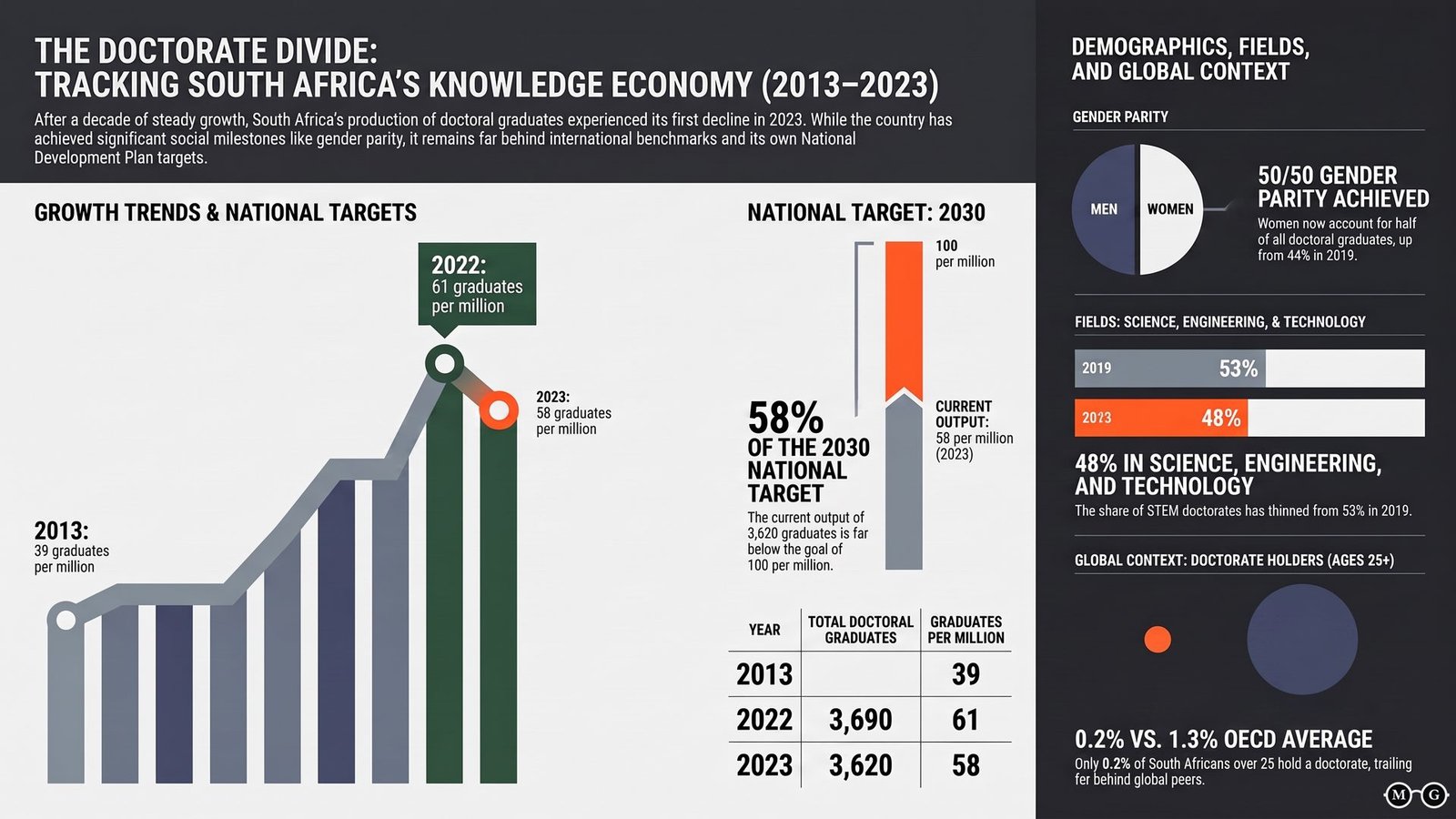
South Africa produced 3,445 doctoral graduates in 2019, 3,552 in 2020, 3,574 in 2021 and 3,690 in 2022, and then 3,620 in 2023, the most recent year for which the official national figures are complete, higher-education data running roughly two years behind. The shape of that sequence matters: a decade of slow climbing, and then, in the latest year, a small step backward. This is not the picture of a system accelerating toward where it needs to be.
The per-million measure, which corrects for the size of the country, tells the same story more sharply. South Africa reached 61 doctoral graduates per million people in 2022 (up from 39 a decade earlier, in 2013) and then slipped to 58 in 2023. The longer trend is real progress, and should be acknowledged: the country lifted its rate by more than half over the decade. But the most recent year is a reminder that progress is not automatic, and can reverse.
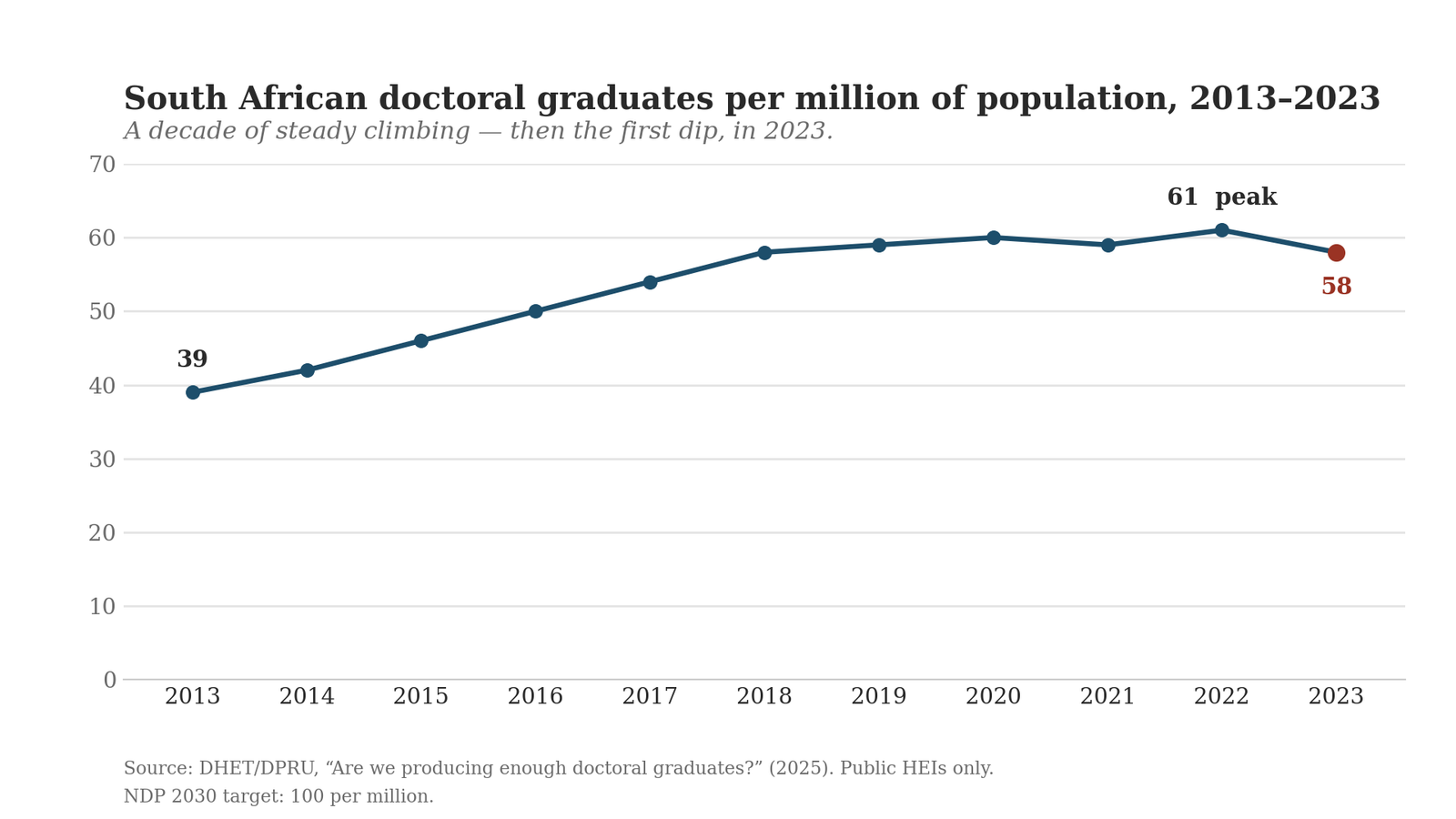
Measured against the country's own ambition, even the high point falls short. The National Development Plan set a target of 100 doctoral graduates per million by 2030: on the order of 5,000 a year. At 3,620 graduates and 58 per million, South Africa is producing barely more than half of what its own plan says it needs, with the deadline now nearer than the baseline.
Who is earning them
The most encouraging movement in the data is not in the totals but in who is achieving them. In 2019, men accounted for 56 percent of doctoral graduates and women 44 percent. By 2023 the two had reached parity: an even split, half and half. A country that a generation ago barred most of its people from advanced study now confers its highest qualification on women and men in equal number. That is a profound social change, achieved in a single generation, and it is worth pausing on before anything else is said.
The distribution across fields tells a subtler story. Science, engineering and technology remain the largest group, at around 48 percent of doctoral graduates, but that share has slipped from 53 percent in 2019. The humanities are the next largest field, with education and with business and management accounting for the remainder. The gentle decline in the science and technology share is worth watching, because a country that intends to industrialise and to solve its own problems in energy, health, water and food cannot afford for its scientific and technical pipeline to thin.
The gap we do not like to name
Growth measured against our own past is one thing. Measured against the world, the picture is sobering. Of South Africans aged twenty-five and older, roughly 0.2 percent hold a doctoral-level qualification. The comparable figure across the OECD averages 1.3 percent; in Germany and Australia it is about 1.9 percent; in India, 3.7 percent. We are producing more doctorates than we ever have, and we remain, on this measure, near the bottom of the international table.
That gap is not a verdict on the ability of our people. It is a verdict on access — on how many young South Africans ever reach the door of a doctorate, and how many are turned back long before it by cost, by under-prepared schooling, by the simple economic necessity of earning rather than studying. The official figures do not consistently record the age at which that doctorate is earned, so I will put no number to it; but its shape is not in dispute, the doctorate is, for most who hold it here, a mid-career achievement earned under pressure and at personal expense, not a straight path walked in one's twenties. The number is low not because the talent is scarce but because the ladder is broken in too many of its lower rungs.
The scholars who cross borders
South Africa's doctorate has quietly become a continental undertaking. By 2019, roughly four in ten doctoral candidates at South African universities were international students, and about a third of all our doctoral candidates came from elsewhere on the continent: up from fewer than one in ten in 2000. In a single generation, the country's lecture halls and laboratories have become one of the places where Africa educates its own. The largest numbers come from Zimbabwe, Nigeria, Ghana, Ethiopia and Kenya, but the roll call runs the length of the continent.
What happens afterward is the part worth dwelling on. Most do not stay: by one careful study, some 55 percent of African doctoral graduates returned to their home countries within a year of graduating, carrying what they had learned back to build universities, ministries and industries at home. A third remained in South Africa and enriched it. Either way, the knowledge did not disappear. It multiplied. A scholar from Harare, Lagos or Accra did not become a sharper researcher because she crossed a border, and she took nothing from anyone by doing so. Knowledge is not a fixed quantity to be guarded at a checkpoint. It is the one form of wealth that grows by being shared.
That is the quiet argument these numbers make. The walls we raise between African countries serve many purposes, real and imagined, but the growth of knowledge has never been one of them. A continent serious about its own intellectual future would let its scholars, its ideas and its research move more freely across its own map, not less. South Africa, for all its strains, has been one of the rooms where that movement happens. It should be proud of that, and widen the door rather than narrow it. The measure of our universities is not only how many South Africans they graduate, but how much of the continent's mind passes through them and is the better for it.
What the numbers ask of us
Read together, the figures describe a country that climbed for a decade, slipped in the most recent year, and remains well short of both the world and its own stated target. By 2023 women and men earned the doctorate in equal number: genuine, hard-won progress that should not be understated. But output is not yet where a serious knowledge economy needs it, and the last year's dip is a warning against complacency. We remain far below the rest of the world in the density of advanced knowledge our society holds; and the continent we are part of is educating a generation of scholars whose talent it must find ways to keep on African soil: wherever on that soil they choose to build.
None of this is a story about any one graduate. It is a story about a ladder — how many can reach it, how far up it goes, and whether the country builds the laboratories and institutions that give a doctorate somewhere to be useful once it is earned. A degree is a private accomplishment. A nation's stock of knowledge is a public asset, and like every public asset it is built deliberately or not at all.
“The future is not an accident.”
Dr Malusi Gigaba is a Scholar-Statesman, an ANC NEC Member, a former Cabinet Minister of the Republic of South Africa, a Member of Parliament, and a member of both the Joint Standing Committee on Defence and the Portfolio Committee on Trade, Industry and Competition.