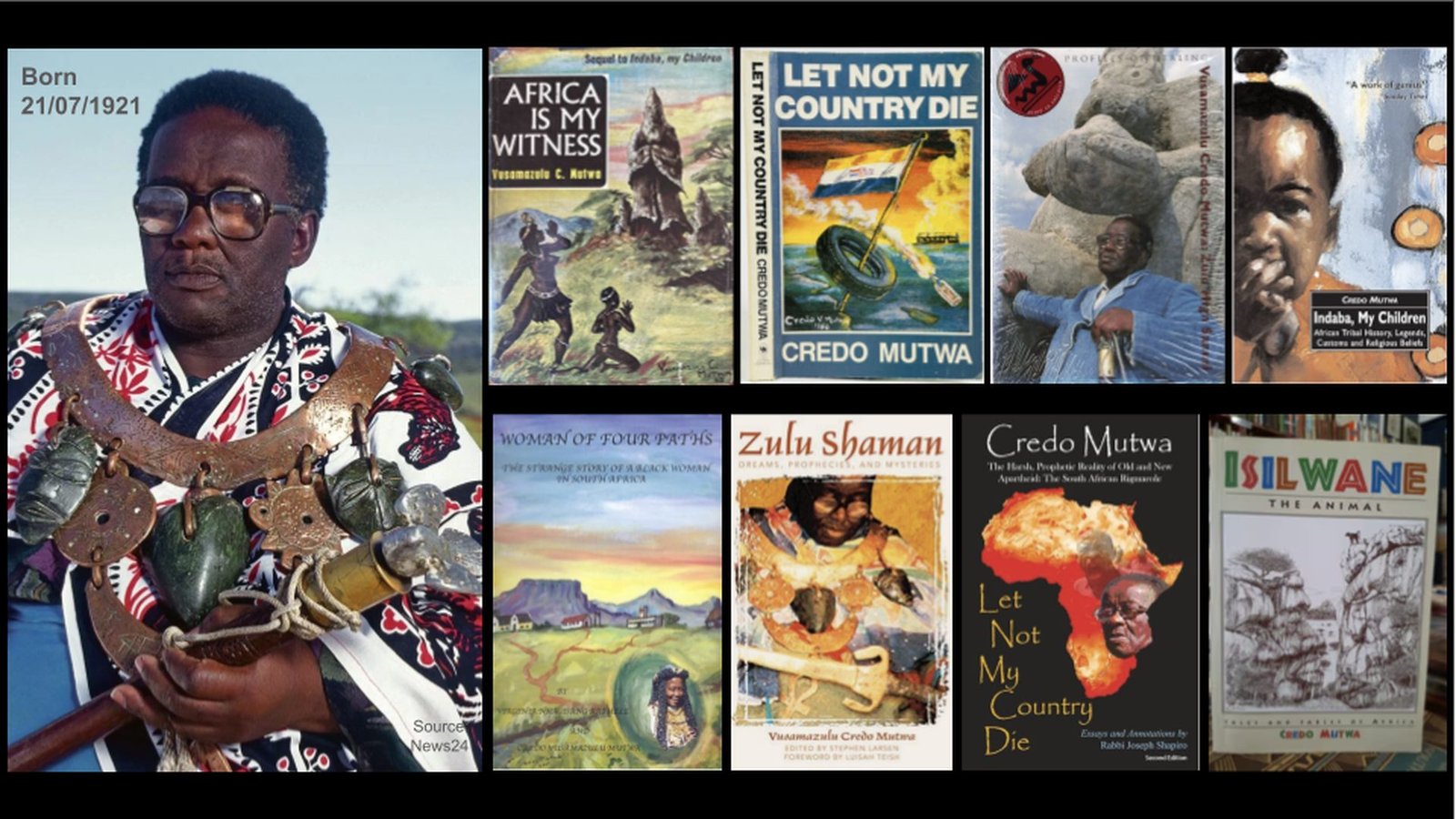
On 21 July 1921, in the hills of Zululand, a child was born who would spend the next ninety-nine years insisting that a people who forget their own story cannot be free. His name was Vusamazulu Credo Mutwa. He died on 25 March 2020 in Kuruman, in the Northern Cape, far from the Zululand of his birth. Today would have been his one hundred and fifth birthday, and it is a fitting day to ask a question he spent his life pressing upon us: who keeps a nation's memory, and what do we lose when no one does?
A life born of two worlds
Mutwa's beginning already carried the fault line that would run through the century he lived in. His father was a Christian builder; his mother held to the older Zulu faith. The two traditions could not be reconciled enough for a marriage, and so he was born, as he told it, a child of that unresolved argument between the imported and the indigenous. It is a small biographical fact with a large meaning, because the tension in that household, between the faith brought by the missionary and the knowledge carried by the ancestor, was the tension of colonised Africa itself.
He came to his vocation through suffering. As a young man he was gravely ill after a violent assault, and in the reckoning of his family this was not misfortune but summons. His grandfather read the illness as a calling, and Mutwa was initiated as a sangoma, a traditional healer — in the older usage, an isanusi, a diviner entrusted with the deepest layers of a people's tradition and the wisdom of the ancients. From that point he understood himself to be a custodian, not the owner of African knowledge, but its keeper on behalf of those who came before and those not yet born.
The storyteller who wrote it down
Mutwa's singular decision, and the one for which he will be longest remembered, was to commit oral tradition to the page. In 1964 he published Indaba, My Children, a vast gathering of Southern African folklore, cosmology and legend that he subtitled, on its title page, “African Tribal History, Legends, Customs and Religious Beliefs.” It was an act of preservation performed under a government that was, in those very years, legislating the erasure of African life from public memory. To publish African cosmology as a serious body of knowledge in 1964 was not a quaint literary gesture. It was a claim to dignity made in the teeth of a state that denied it.
Other books followed across the decades — Let Not My Country Die in 1986, Song of the Stars in 1996, Zulu Shaman in 2003, Woman of Four Paths in 2007. How well they sold was never carefully counted, the sales of an African book first published in 1964 are precisely the kind of record we did not keep, but the endurance of the work is its own measure. Indaba, My Children has passed through edition after edition across more than half a century, carried by international publishers and retold, in 2011, as a graphic novel, and it remains in print today. Formal recognition came late. In 2017, at the age of ninety-six, the South African Literary Awards honoured his body of work with their Lifetime Achievement Literary Award, in a citation that called it “a major contribution to Africa and the world's knowledge reservoir.” The boy born of the argument between two worlds had become one of the most published custodians of the older one: honoured, at last, a lifetime after he had begun.
The artist and the village
He did not only write. Mutwa drew and sculpted, and he built. In 1975, fearing that African culture was slipping beyond recall, he established Kwa-Khaya Lendaba, a living cultural museum in Soweto: a place where the sculptures, symbols and stories he had gathered could be seen and walked through rather than merely read.
The fate of that village is part of the honest record of his life, and it should not be smoothed over. Parts of it were destroyed during the 1976 Soweto uprising, and again during a strike in 1980. That his monument to memory was caught in the fire of the very struggle for liberation is one of the painful ironies of the period, a reminder that the keepers of culture and the makers of political history did not always recognise one another as allies, even when they were fighting the same oppression. Mutwa eventually left the area. The work of preservation, he learned, is not protected from the turbulence it hopes to outlast.
The chapter we did not keep
Where he went next, we know only in outline. He built another cultural village at Lotlamoreng, near Mahikeng; and in his later years he made his last home in Kuruman, a town in the Northern Cape far from the Zululand of his birth, where he lived with his wife, Virginia Rathele, and cared for the sick until his death in 2020.
What is missing from the common account is not, in truth, lost. Much of it he and Virginia set down in their own pages; more of it lives still in the memory of the woman who nursed him to the end. But it has not been gathered, not taught, not held in the shared record where a nation keeps what it means to remember. The man who spent a lifetime recording the memory of others is himself, by us, barely kept. That is not an accident of his life; it is a verdict on ours. We are quick to keep the record of those who governed, and slow to keep the record of those who remembered. If even the last chapter of our most published custodian sits ungathered on a shelf and in a widow's memory, we might ask honestly what chance the unwritten knowledge of a million anonymous elders ever had.
The argument he leaves us
It would be a disservice to Mutwa, and untrue to the standards he himself worked by, to pretend he was a figure beyond dispute. He was not. Scholars have long debated where the recorded tradition in his work ends and where his own extraordinary imagination begins; some regarded him as the faithful scribe of an ancient inheritance, others as a gifted inventor who wrote new myth in the voice of old. That argument has never been settled, and it need not be settled today.
What matters is that the argument exists at all, because it is an argument about something we were once told had no value worth debating. A people confident in their heritage can afford to interrogate their own custodians. They can hold a man in honour and still question his sources. The colonial project sought to make that conversation impossible by denying that African knowledge was knowledge in the first place.
Mutwa belongs in the tradition of ancient African philosophers, poets and visionaries: those who first imbibed knowledge and, in turn, educated the ages. Many of these philosophers, poets, visionaries, mathematicians and astronomers of old became the mentors of many educators during the ancient civilisations in Timbuktu (Mali) and Egypt. Their works, knowledge and wisdom were stolen and expropriated by Greeks and Romans, transported to Europe and turned into “ancient Greek and Roman” wisdom by their mentees, without acknowledgement, as part of their colonial project to destroy the African roots of civilisation and knowledge, and to deny Africa's role in the development of modern knowledge and wisdom. We will do well never to forget these educators, and to keep reminding our youth that they are the offspring of ancient producers, preservers and disseminators of knowledge and wisdom.
Mutwa's enduring achievement is that he forced the conversation onto the table and kept it there for half a century. We argue about Credo Mutwa because he made African memory important enough to argue about. That is not a footnote to his legacy. It is the legacy.
On this day, one hundred and five years after his birth, the task he set is unfinished. Our archives are still thin. Our languages are still under-recorded. Too much of what our grandmothers knew still leaves the world with them, unwritten. Mutwa spent a century trying to hold that door open. The least we owe him is to keep walking through it.
“The future is not an accident.”
Dr Malusi Gigaba is a Scholar-Statesman, an ANC NEC Member, a former Cabinet Minister of the Republic of South Africa, a Member of Parliament, and a member of both the Joint Standing Committee on Defence and the Portfolio Committee on Trade, Industry and Competition.