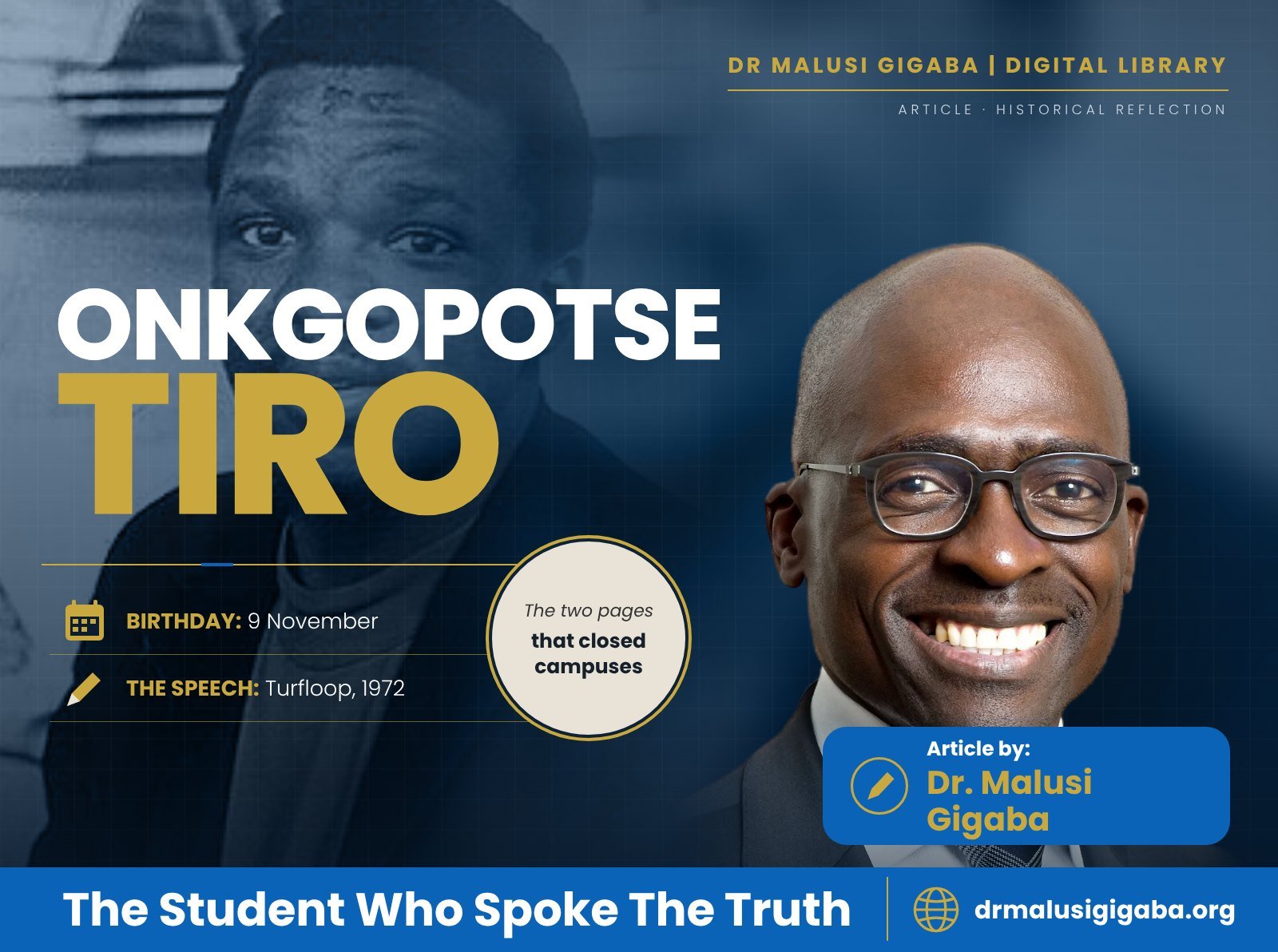
Today, 9 November, is the birthday of Onkgopotse Ramothibi Tiro. At least two schools carry his name, Onkgopotse Tiro Comprehensive outside Mafikeng and a primary school in Roodepoort, and so do a hall and a road at the university where he spoke. Yet when the country tells the story of its student revolt, he is too often a clause in someone else’s sentence. There are few photographs of him and no film footage, the Mail & Guardian reported in 2008. What survives is a speech. In the AZAPO biography that reprints it, it runs to two pages.
Two pages. They cost a young man his place at the university, then his job, then his country, and in the end his life. I do not say that for effect. The record says it for me.
That record is thinner than it should be, and it is hard to find. Much of what I could verify about his life, and about the weeks after his speech, rests on two documents and on speeches by his family and those who knew him. The documents are a short biography published by AZAPO and a scholarly article by Anne Heffernan of the University of Oxford. I draw on all of them below. A man whose words moved a country is, online, held up by few supports.
Where he came from
Onkgopotse Tiro was born in Dinokana, near Zeerust. The AZAPO biography says he was the eldest of five children. Dr Muzi Sikhakhane S.C, speaking at the University of Limpopo’s 11th Onkgopotse Tiro Memorial Lecture on 11 September 2026, described Tiro’s mother as a single mother and domestic worker, and said Tiro was named after his uncle. On what that name asks of us, Dr Sikhakhane quoted, as he recalled it, Dr Mosibudi Mangena, the former AZAPO president:
we don’t remember you because your name demands it but because your heroic deeds force all men and women of conscience to do so.
His first lesson in protest came before he was old enough to take part in one. In 1957 the women of Lehurutshe and Dinokana rose against passes for women, and Heffernan records that the Native Commissioner of Dinokana closed the school Tiro attended. His schooling went on in pieces, at Zeerust, Soweto and Mafikeng. A pass-law violation sent him home from Soweto, and he finished at Barolong High School in Mafikeng.
His principal there, C. N. Lekalake, remembered him as hard to handle:
because he did not hesitate to object openly to whatever he thought was wrong.
When Tiro finished matric, his class chose him to speak at its leavers’ party. Heffernan quotes Lekalake saying that the speech, about the conditions the pupils were subjected to, was so influential that changes were made at once in the school’s administration. To pay his school fees, she adds, Tiro worked at odd jobs and on a manganese mine as a dishwasher. A bursary then took him to the University of the North, where, according to his nephew’s biography, he read for a Bachelor of Arts degree in History and Psychology.
I read in that a young man who had already watched a protest close his school, and who had already moved a school’s administration with a speech. He arrived at Turfloop aware of politics.
The organisation behind him
The South African Students’ Organisation, SASO, was formed in December 1968 by black students who had come to feel that the multiracial National Union of South African Students, NUSAS, did not speak for them. The Mail & Guardian records that a NUSAS conference that year was the tipping point. South African History Online’s timeline records that SASO was inaugurated at Turfloop on 1 July 1969, with Steve Biko as its first president and Barney Pityana as its secretary. Biko is the name we remember, and rightly. But SASO was founded by a group of students, and the paper speaks of its founders and early leaders, of whom Biko was the most prominent. Heffernan names Harry Nengwekhulu, a Turfloop student, as a founding member. South African History Online records that he was elected president of the Turfloop Students’ Representative Council.
Turfloop mattered to SASO. Heffernan records that the university hosted and funded SASO’s first conference, and that the Students’ Representative Council affiliated the whole student body to it at once, by a majority vote. Tiro, then a student at Turfloop, was in the hall in July 1969. When he led the council in 1970–71, she writes, the links between the council and SASO grew.
A graduation, and a speaker his classmates chose
The year had already begun badly. In February 1972, the diary the Students’ Representative Council had prepared for the students came back from the printers with its political pages removed, and the students demonstrated against the censorship.
On 29 April 1972, Turfloop, now the University of Limpopo, held its graduation ceremony. The Students’ Representative Council, led by Aubrey Mokoena, had invited Tiro, who had led the council the year before, and the graduating class chose him as its speaker, the Mail & Guardian records. Also speaking that day was Mokgama Matlala, who headed Lebowa’s government and spoke in favour of Bantu education.
His nephew and biographer, Gaongalelwe Tiro, records in Parcel of Death that he completed his degree at the end of 1971 and stayed on in 1972 as a graduate student, studying for a University Education Diploma. He was still a student of the university when he rose to speak. What he delivered was an argument. He told his listeners:
no man, no matter how many tanks he has, will reverse the course of events.
And he said that an education not linked with the entire continent of Africa was meaningless.
He opened by taking the Prime Minister, Mr Vorster, at his word: that no Black man had landed in trouble for fighting for what was legally his. Then he went through his own campus. He answered a Lebowa official’s defence of Bantu education by pointing out that America has one education for all its children, and asked what in European education was not good enough for the African. He objected that education diploma students had to study Philosophy of Education in Afrikaans, and that the advisory council said to speak for their parents had not been elected by them. He said a Black man had been turned out of the campus bookshop, and that white students were given vacation jobs while Black students who owed fees went without. He said parents who had travelled a long way were locked outside the hall. Then he turned to his fellow graduates.
The university had been founded in 1959 to educate a black elite for the Bantustans, and its founders imagined a community that Heffernan calls “very narrowly bounded”, a single ethnic group. The speech reached for an entire continent. That is the antithesis at the heart of this story: not a campus built to divide and a student who was angry, but a campus built to divide and a student who spoke of Africa. Dr Sikhakhane read the speech differently, and I record his reading as his: in his view, what Tiro was questioning in it was the dominance of whiteness in South African academia. Mandla Seleoane, who was a student at Turfloop that year and was expelled with the rest, put the weight elsewhere. On the Moya Politics podcast he called it an ordinary speech and found its force in its plainness: Tiro called things by their names, in front of the chiefs, officials and lecturers he was criticising.
What did the system fear? It did not fear an insult. It feared an idea.
What the university did
The Rector, J.L. Boshoff, and the university’s advisory council expelled him, judging that he had abused the platform he was given. The senate, whose members were all white, agreed. Black members of the academic staff walked out in protest, and Heffernan records that they went on to form the Black Academic Staff Association. The students resolved to boycott lectures “until such time that Mr. Tiro be readmitted or tried before a tribunal.” The university’s answer was to expel every student and to require each to apply for readmission, on conditions that included a pledge that Tiro would not be readmitted. The members of the Students’ Representative Council who had invited him were expelled for good.
The AZAPO biography records that the whole student body, 1,410 students, was expelled. It records that a delegation of senior black leaders, among them Dr Nthato Motlana, went to Turfloop to ask the Rector to reverse his decision, and that the effort drew a blank. And it records that as Tiro was driven away he quoted the Bible to the Rector: “For we can do nothing against the truth, but for the truth” (2 Corinthians 13:8). It gives him one more line, and it is the truest sentence in the record:
The expulsion has made me realise that one can be punished for saying two plus two make four.
A campus became a movement
The argument did not stay at Turfloop. On 13 May 1972, in the week after the mass expulsion, forty delegates at a South African Students’ Organisation formation school in Alice adopted what became known as the Alice Declaration. It called on all black students to “force the Institutions/Universities to close down by boycotting all lectures.” Heffernan records that students at Fort Hare, the Western Cape, Zululand and Durban-Westville took it up, and that each of those universities was closed for a time during the winter of 1972.
I am wary of tidy lines of cause, and I will not draw one from Turfloop to every student revolt that followed. I will point only to the title of Heffernan’s 2015 article in the Journal of Southern African Studies, which places him at the source of what it calls “the Seeds of South Africa’s Student Movement in the 1970s.”
A teacher, then an exile
Within weeks of his expulsion, Heffernan records, Lekgau Mathabatha, the principal of Morris Isaacson High School in Soweto, hired him to teach English and History. Among his pupils was Tsietsi Mashinini. Heffernan records that Mashinini’s first political exposure was in Tiro’s history classes at Morris Isaacson, and that he later chaired the Soweto Students’ Representative Council, which played a critical organisational role in June 1976 and its aftermath. Tiro was not alone: she notes that more than ten former Turfloop students moved into Soweto classrooms as teachers between 1972 and 1975. I do not claim that Turfloop caused 1976. I record who was in the classroom.
Teaching did not end his organising. He moved to Soweto to stay with his mother and became a key SASO organiser at the time, at the executive level. Professor Harry Ranwedzi Nengwekhulu, SASO’s permanent organiser at the time, said that SASO kept layers of leadership, so that others could take over at once if its leaders were banned, and that Tiro was attached to him because they knew he was a good organiser. At Morris Isaacson, between 1972 and 1973, Tiro worked to bring Black Consciousness to the pupils there, and Mandla Seleoane remembers him as president of the South African Students’ Movement. Nengwekhulu was banned in 1973, and Tiro followed him as permanent organiser.
Heffernan records that Tiro was dismissed in February 1973, after months of confrontation between the school committee and the Bantu Education Department. In September of that year he fled to Botswana.
The parcel
On 1 February 1974, at St Joseph’s Catholic Mission in Khale, near Gaborone, Onkgopotse Tiro was killed by a parcel bomb. Heffernan records that the parcel allegedly bore the markings of the International University Exchange Fund, that it was addressed in longhand, and that it was hand-delivered by a priest with whom Tiro was living. The Fund denied sending it and blamed the South African government. Mandla Seleoane says that, because of the Fund’s name, the parcel was taken to belong to the exchange programme. South African History Online records that Nengwekhulu, who crossed into Botswana in September 1973, worked with Sweden and that same fund to obtain scholarships for exiled Black Consciousness members. I draw no line between the two facts that the record does not draw. I note only that the fund’s name was one exiled students had reason to trust. The Truth and Reconciliation Commission’s record states that “the identity of the perpetrators has not been established,” and that “available evidence indicates that the assassination was the result of a South African security force operation.” No one came forward to claim responsibility, the Mail & Guardian reported in 2008. The Commission’s Final Report went further, as I set out at the end.
Pandelani “Bra Nef” Nefolovhodwe sat on the Students’ Representative Council committee that invited Tiro to speak in 1972, and is currently the chairperson of the University of Limpopo’s council. Speaking on camera at the Tiro Memorial Lecture hosted by Freedom Park, he said of Tiro:
… he was the first person in this country to have been parcel bombed … the others came later.
The Truth and Reconciliation Commission records the killings of Tiro and John Dube, within two weeks of each other in February 1974, as the first known cross-border assassinations of that period.
The Botswana government condemned the killing. More than 1,200 people attended a special ceremony in his memory at the Catholic cathedral in Gaborone, Heffernan records.
His mother, Moleseng Anna Tiro, a single mother and domestic worker, told the Commission on 29 April 1996, twenty-four years to the day after her son’s speech: “this was my first child. I was battling to get him educated.” She asked the Commission to find out who killed him, and she wanted him buried at home. Dr Sikhakhane said the apartheid regime refused to let his body be brought home. His remains were returned to South Africa on 20 March 1998, and he was reburied at Dinokana two days later, according to the South African History Online biography.
What the two pages ask of us
I said at the start that what survives of Tiro is a speech. I will end with what it asks. It does not ask us to admire a martyr. It asks a harder question: whether the education we offer our young people is linked to the continent they live on, or only to the job they hope to get.
A system that could not answer a student’s argument answered it with expulsion, then dismissal, then exile, and in the end with a parcel bomb. The Truth and Reconciliation Commission found that the former state and its Minister of Law and Order were responsible for his assassination. The idea outlived them.
We owe him two things. The first is accountability. His mother asked the Commission in 1996 to find who killed him. It found, in all probability, that the work was done by members of the Z Squad, the operational arm of the government’s intelligence agency of the day, BOSS, and that the state was responsible. Searched the Commission’s Final Report, the Parliamentary Monitoring Group’s 2022 briefing on Commission prosecutions, the Mail & Guardian, The Journalist and the web on 5 November 2026; did not find a prosecution or an inquest. A commission under retired Justice Sisi Khampepe is sitting now, hearing why cases the Truth and Reconciliation Commission referred for prosecution stalled. Its report is due on 18 December 2026. Having searched the list of cases at unfinishedtrc.co.za and the coverage of the commission that I could reach on 6 November 2026, I did not find Tiro’s case named among those before it. Botswana’s police did investigate in 1974, The Journalist records, and released the man they detained without charge.
The second is simpler, and it is within every one of our reach. Read what he said. Then ask what we are teaching our children, and who it is for.
“The future is not an accident.”
Dr Malusi Gigaba is a Scholar-Statesman, an ANC NEC Member, a former Cabinet Minister of the Republic of South Africa, a Member of Parliament, and a member of both the Portfolio Committee on Trade, Industry and Competition and the Portfolio Committee on Justice and Constitutional Development.