In its January 1911 issue, South Africa wrote in its editorial on "Native Higher Education" that White South Africans were very interested in the welfare and civilisation of the South African Natives, particularly in the area of higher education. However, the editorial remarked, the lack of higher education opportunities among the natives "had led to a number going to America in search of college instruction, where they imbibed ideas of a racial and political character such as were not in accordance with the peaceful development of South Africa." Of course, were they not serious in these assertions, this would be laughable and taken as a lousy April fools' joke.
As a result, the colonialists considered the establishment of colleges such as Fort Hare as pivotal to the achievement of this objective of "uplifting the natives and … putting them upon a path which should lead to their permanent elevation as a race, by which means alone can they come to take a worthy share, under European guidance and control, in the future of their native country."
Now herein lay the façade in that the white colonialists had no such interest in the welfare and civilisation of the natives or in their elevation as a race. Besides it being a façade, this was an insult to the natives, especially given the nonsensical view that such education would have to take place "under European guidance and control," be in accordance with the "peaceful development of South Africa," and all in the interests of "the future of their native country." Which native country, because they had been forcefully robbed of their native country and consigned to unproductive rural reserves!
However, what the above underscores is the role of colonial education. The colonial state, insofar as that consists of the establishment of the attendant legal and institutional framework, required that the colonial administration, acting on behalf of the colonial and metropolitan bourgeoisie, had not merely to replicate the institutions and systems which it had established in the metropolitan country itself. Additionally, it had to create a state apparatus, institutions and systems, including particularly the ideological systems – cultural, educational, religious – through which it could exercise dominion over all the indigenous social classes in the colony.
Carter G. Woodson thus would opine that modern education, despite its flaws, benefits those who enslaved and oppressed others far more than it benefits Black people. It was designed around the oppressors' needs, producing philosophies that justify slavery, segregation, and lynching, granting the oppressor the right to exploit and kill while teaching the oppressed that their subjugation is divinely ordained. This system controls the Negro's mind, so that rather than needing commands, he internalises his "proper place." While it inflates the oppressor's sense of superiority, it crushes Black genius by instilling a belief that his race is inferior. The "educated Negro" ends up a liability, despising his own people while rejecting white society, caught in a cycle of denouncing both. Inferiority is drilled into him in every class and textbook.
Ya Gragramla tells the historical truth, which remains to this day the fact, that:
"All the centres of power in South Africa were at one with regard to these two matters: that the whites had to unite because they shared a common destiny; and that they had a common responsibility to manage the natives."
In resolving the native question, the colonial and their successive supremacist regimes had to resolve what to do with black labour. Therefore, while black labour had to be kept uneducated as much as possible, to keep it cheap and in bondage, some among black people needed to obtain education sufficient enough to ensure the reproduction of cheap labour for the sustenance of racial capitalism and white supremacy. Hence the establishment of higher education colleges for black people.
The natives educated "under European guidance and control," such as Booker T. Washington, the "educated Negro" to whom Carter G. Woodson referred, regarded higher education merely as a passport to social and professional standing that had nothing to do with political agitation. On the contrary, others such as Monroe Trotter, W.E.B. du Bois and ZK Matthews in South Africa rejected this narrow view and the belittling of the very struggle that secured Washington's own freedom. These saw higher education not just as a career tool but as essential to collective empowerment, recognising political agitation not merely as "abstract eloquence," but as necessary for true freedom to pursue the everyday goals Washington preached in an abnormal society.
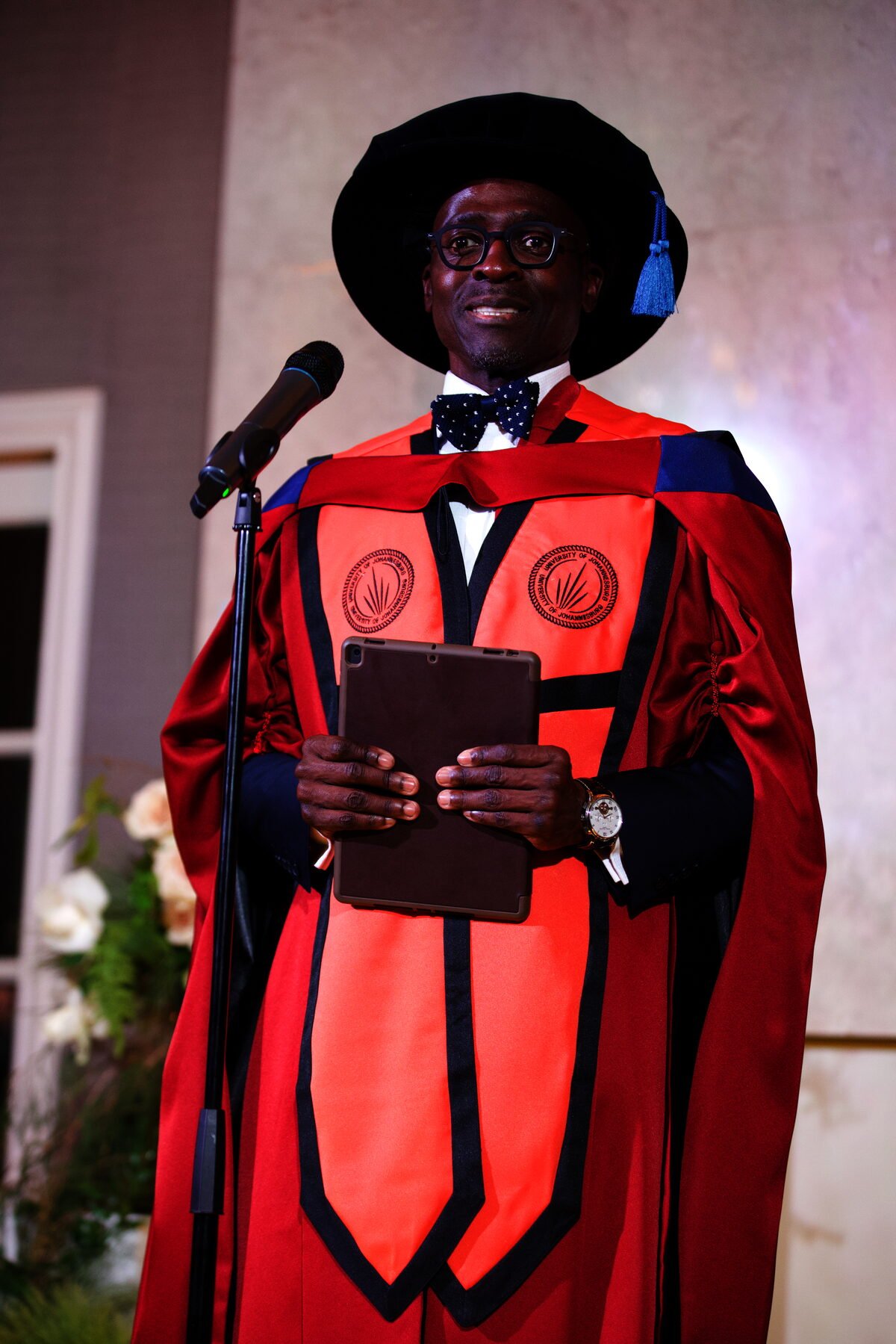
Thus to reject this notion that the oppressed must only preoccupy themselves with social and professional progress was to reject in totality the notion that the oppressed could make any progress under the auspices of their oppressors. I have therefore regarded this milestone, not just as personal, but as a continuation of a centuries-long struggle by various African intellectuals to expose and destroy coloniality.
Here is a profound truth: for Black people, academic achievement is never a neutral act. It is a political rebuke. Every single time a Black student opens a book, solves an equation, or defends a thesis, they are defying a history that tried to tell us we were only meant for labour, not for thought. We are rejecting "our place" as determined for us by the colonial supremacists.
Colonialism was not just the theft of land; it was the theft of our intellect. It was a system designed to keep us from the library, the laboratory, and the lecture hall. It told us our history began with enslavement and our future ended with servitude. But we have awakened. The Black intellectual today is no longer a novelty; they are a responsibility. When you earn that degree in engineering, you are not just building bridges — you are dismantling the walls of the plantation. When you publish that paper in philosophy, you are reclaiming the ancient wisdom of Kemet and Timbuktu that colonial powers tried to erase. To be a Black intellectual is to understand that your mind is the most dangerous weapon against the status quo. It is to know that every thesis defence is a protest, and every graduation ceremony is a victory march.
So, let us be clear: we are not learning just to get a job. We are learning to liberate. We are learning because our ancestors whispered equations in the dark while they plotted their escape. We are learning because intellectual rigour is the ultimate proof that we are the architects of our own destiny.
In rejecting coloniality, we affirm the truth stated by Chinua Achebe that:
"Because colonialism was essentially a denial of human worth and dignity, its education programme would not be a model of perfection. And yet the great thing about being human is our ability to face adversity down by refusing to be defined by it, refusing to be no more than its agent or its victim."
“The future is not an accident.”
Dr Malusi Gigaba is a Scholar-Statesman, an ANC NEC Member, a former Cabinet Minister of the Republic of South Africa, a Member of Parliament, and a member of both the Joint Standing Committee on Defence and the Portfolio Committee on Trade, Industry and Competition.